Every security officer uniform sends a message before a single word is exchanged with a client, a visitor, or a potential threat.
One of the quickest ways to identify an inexperienced security officer isn’t by the questions they ask.
It’s by the equipment they want to wear.
Over the years, I’ve noticed the same pattern. A new officer gets assigned to an armed post and immediately assumes they’re walking into a high-risk environment. Before long, they’re asking if they can wear a tactical plate carrier, bring their AR-15, or keep a shotgun in the patrol vehicle.
Their intentions are usually good. They want to be prepared.
The problem is that they haven’t yet learned one of the most important lessons in this profession:
The mission determines the equipment—not the other way around.
Looking Tactical Isn’t the Same as Being Prepared
One of the best examples I can remember happened years ago when an officer proudly showed up to work wearing a tactical plate carrier he had purchased from an Army surplus store.
He looked the part.
There was just one problem.
The vest didn’t contain ballistic plates.
It wasn’t body armor at all.
It was simply a nylon carrier designed to hold armor that wasn’t there.
He believed he had made himself safer when, in reality, he had only created the illusion of protection.
That’s more than just a fashion mistake—it can become a safety issue. When someone believes they’re protected, they’re sometimes willing to take risks they otherwise wouldn’t.
Equipment should solve problems, not create them.
Dress for the Assignment: Security Officer Uniform Guidelines
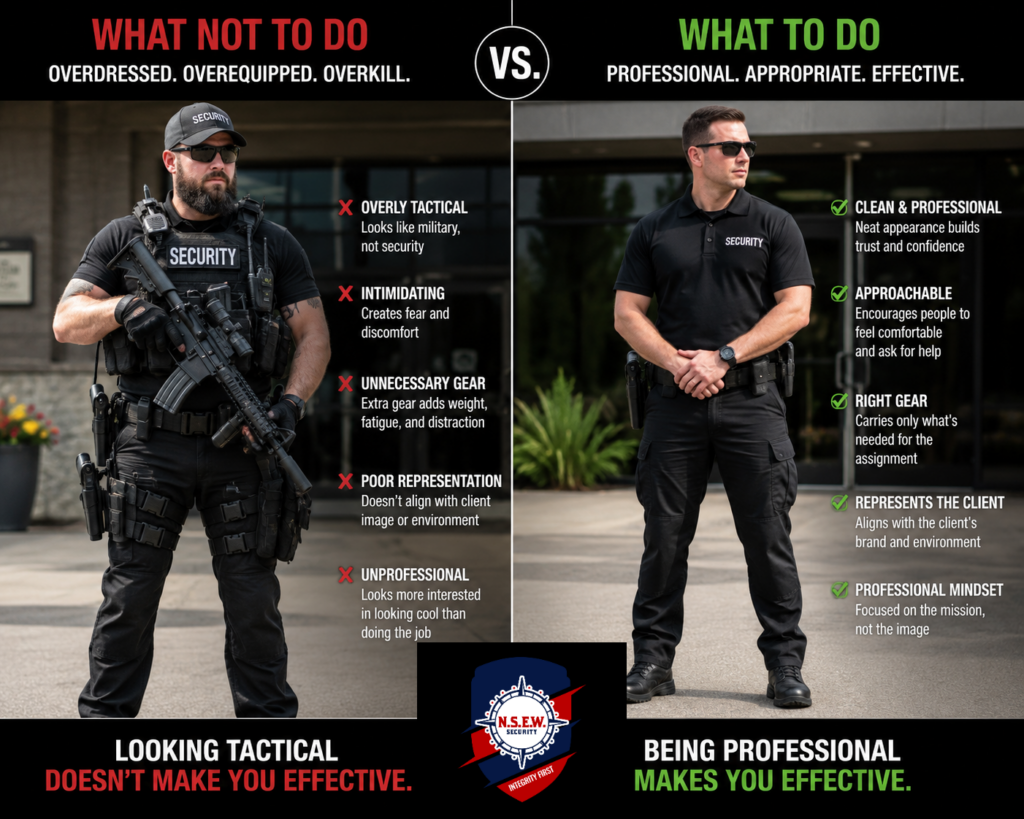
At NSEW Security, our standard uniform is simple: a company polo shirt paired with tactical cargo pants.
That baseline security officer uniform is designed to look professional and approachable in nearly any environment.
From there, the equipment changes based on the assignment.
Some jobs require nothing more than a professional appearance and excellent customer service.
Some require an armed officer.
Some officers choose to wear body armor, and I fully support that decision if they believe it enhances their safety. Our policy, however, is that ballistic protection should be worn as a concealed vest rather than an external tactical carrier.
That policy isn’t about discouraging body armor.
It’s about maintaining a professional, consistent appearance while still allowing officers to protect themselves.
Why We Have a Company-Wide Security Officer Uniform Policy
I want to make one thing clear.
I’m not against external plate carriers.
There are some exceptionally well-designed carriers on the market that look sharp, function well, and absolutely have a place in the right environment.
The challenge isn’t the one officer with a professional setup.
The challenge is creating a policy that’s fair, consistent, and practical for an entire company.
If I allow one officer to wear an external carrier, I have to be prepared to let everyone wear one.
That’s where reality sets in.
Private security isn’t a high-paying profession for most officers. Quality equipment is expensive, and many officers understandably buy whatever they can afford.
Before long, one officer has a professionally configured carrier, another has a bargain-bin carrier that’s sagging off one shoulder, another has every pouch imaginable attached to it, and someone else is wearing an empty surplus vest that offers no ballistic protection whatsoever.
Now the company no longer has a professional appearance.
It has a collection of personal opinions about what “looks tactical.”
As a company owner, I can’t build policies around the best-case scenario.
I have to build them around what will work consistently across the entire organization.
A concealed ballistic vest gives officers the protection they want while ensuring every officer presents the same professional image to our clients and the public.
You’re Representing More Than Yourself
Every time an officer puts on a uniform, they’re representing more than themselves.
They’re representing the security company.
They’re representing the client who hired us.
They’re representing the property they’re protecting.
And whether they realize it or not, they’re representing the private security profession.
Imagine checking into a quiet hotel for a family vacation.
Instead of seeing a clean, professional security officer standing in the lobby, you’re greeted by someone wearing a tactical plate carrier covered in pouches, multiple magazines, gloves clipped everywhere, and enough equipment to look like they’re preparing for a military operation.
What’s your first thought?
Most people won’t think,
“This place has excellent security.”
They’re much more likely to think,
“What happened here?”
Or…
“Is this place dangerous?”
That officer may feel more confident.
But the client has just lost something valuable—the comfortable, welcoming atmosphere they’re trying to create.
Security should make people feel safe.
Not make them wonder why so much equipment seems necessary.
Professionalism Is the Greatest Deterrent
Research has consistently shown that people form opinions about professionalism, authority, and trustworthiness within seconds of seeing someone in uniform. Long before an officer says a single word, people have already formed an impression based on appearance, posture, grooming, and confidence.
I’ve found the same thing to be true after years in this profession.
People don’t feel safer because an officer is carrying more equipment.
They feel safer because the officer looks like they know exactly what they’re doing.
A clean uniform.
Professional grooming.
Well-maintained equipment.
Good posture.
Situational awareness.
Confidence without arrogance.
Those qualities inspire far more confidence than trying to look as tactical as possible.
The same is true for the people looking to commit crimes.
Most aren’t evaluating how many pouches are attached to an officer’s vest.
They’re looking for distraction, complacency, and easy opportunities.
A disciplined, alert officer is a far greater deterrent than someone wearing unnecessary equipment.
Equipment Carries Responsibility: Security Officer Uniform and Gear
One lesson I try to teach every new officer is this:
Every piece of equipment you wear creates an expectation that you know how to use it.
If you’re carrying OC spray, people assume you’ve been trained to use it.
If you’re wearing body armor, they assume you understand its capabilities and limitations.
If you’re carrying specialized equipment, they assume you’ve been trained, qualified, and authorized to use it appropriately.
Equipment isn’t decoration.
It’s a responsibility.
Industry groups like ASIS International publish similar guidance on professional conduct and equipment standards for private security officers.
What About AR-15s and Shotguns?
One of the questions I hear most often from new armed officers is whether they can bring an AR-15 or a shotgun to work.
Our answer is no.
Not because those firearms don’t have legitimate applications—they absolutely do.
But none of our current contracts require them, and carrying them simply because they look impressive or make someone feel more prepared isn’t a professional reason to have them.
Could that ever change?
Absolutely.
If we were awarded a contract that legitimately required patrol rifles or shotguns, we would develop detailed policies, provide extensive training, establish qualification standards, and ensure the client specifically required that level of security before authorizing their use.
Professional decisions are based on operational necessity—not personal preference.
Final Thoughts
The longer I’ve worked in private security, the more I’ve realized that professionalism is usually quiet.
The officers who earn the most respect are rarely the ones trying hardest to look tactical.
They’re the ones who show up prepared, stay alert, communicate well, exercise good judgment, and represent both their company and their client with professionalism.
Dress for the assignment you’re actually working.
Not the one you’ve imagined.
Because at the end of the day, your uniform isn’t there to make you look important.
It’s there to make your client look protected.
If you take your security officer uniform and conduct this seriously and want to work for a company that does too, take a look at our current openings on the Careers page.