
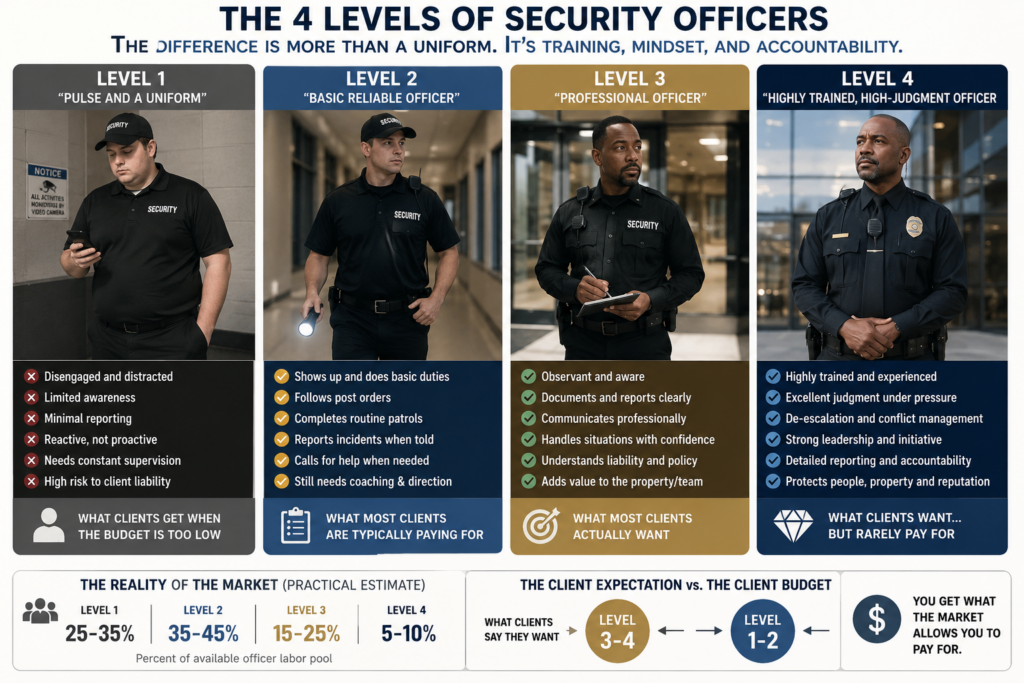
Every client wants the same thing when they hire a security officer.
They want a sharp, reliable, professional officer who shows up early, looks squared away, writes detailed reports, handles conflict calmly, notices problems before they become expensive, understands liability, communicates well with management, and makes good decisions when nobody is watching.
In other words, most clients describe a Level 4 security officer.
The problem is that many want to pay a Level 1 price.
That mismatch is one of the biggest problems in the private security industry.
The U.S. Bureau of Labor Statistics describes security guards as workers who patrol property, enforce rules, monitor alarms and surveillance systems, respond to emergencies, deter criminal activity, control building access, and write reports on what they observe while on duty. Those responsibilities sound simple on paper, but doing them well requires judgment, discipline, communication, awareness, and consistency.
The Four Levels of Security Officers
At NSEW Security, we look at officer quality realistically. Not every person in a uniform brings the same value to a property.
Level 1: The “Pulse and a Uniform” Officer
This is the lowest level of service. The officer may technically be present, but that is about it.
They may need constant supervision. They may miss obvious problems. Reports are weak or incomplete. They may not understand how their conduct affects the client’s liability, reputation, or tenant experience.
This is the level clients usually say they do not want, but it is often the level the market produces when the pay is too low.
Level 2: The Basic Reliable Officer
A Level 2 officer can usually show up, follow basic post orders, remain visible, complete routine patrols, and call a supervisor when something happens.
This officer may be dependable, but they are not yet highly polished. They may still need coaching on report writing, conflict management, customer service, situational awareness, and professional decision-making.
For some low-risk posts, a solid Level 2 officer may be appropriate. But clients should not confuse basic reliability with high-level security performance.
Level 3: The Professional Security Officer
A Level 3 officer is where professional security starts to become noticeably valuable.
This officer understands that security is not just about standing there. They observe. They document. They communicate. They understand the importance of access control, lighting issues, doors left unsecured, suspicious activity, safety hazards, and detailed reporting.
They can interact with tenants, employees, customers, vendors, and law enforcement without creating unnecessary problems.
This is the officer most commercial clients are actually trying to hire.
Level 4: The Highly Trained, High-Judgment Security Officer
A Level 4 officer is not just experienced. They are mature, reliable, well-trained, professional under pressure, and capable of making sound decisions in complicated situations.
They understand de-escalation, documentation, liability, customer service, chain of command, emergency response, and professional presence. If armed, they understand the seriousness of carrying a firearm on someone else’s property.
This is the officer clients usually picture when they ask for “good security.”
But Level 4 officers do not stay in Level 1 pay jobs for long.
What the Labor Market Tells Us
The Bureau of Labor Statistics reported that the median annual wage for security guards was $38,370 in May 2024, with the lowest 10 percent earning less than $29,800 and the highest 10 percent earning more than $59,580. That gap matters because it shows what most people already know from experience: the security industry has a wide range of worker quality, responsibility, and compensation.
Locally, the numbers are even more important. For the Gulfport-Biloxi area, Mississippi’s labor data listed security guards at an entry-level hourly wage of $12.11, a mean wage of $15.31, and an experienced wage of $16.89. Statewide, Mississippi listed security guards at an entry-level hourly wage of $11.25, a mean wage of $15.26, and an experienced wage of $17.24.
Mississippi’s report also notes that its “entry-level” and “experienced-level” wage rates are calculated from the wage distribution, not directly collected as official BLS experience categories. That is an important distinction, but the numbers still help show the reality of the market.
A Realistic Breakdown of the Officer Market
Because there is no official Level 1–4 ranking system, the percentages below should be presented as a practical recruiting model, not as government statistics.
| Officer Level | Practical Share of Available Labor Pool | What Clients Usually Want | What Clients Often Budget For |
|---|---|---|---|
| Level 1 | 25–35% | Almost no one wants this | Too many budgets create this |
| Level 2 | 35–45% | Acceptable for basic posts | Common budget target |
| Level 3 | 15–25% | Most clients actually want this | Requires better pay and supervision |
| Level 4 | 5–10% | Frequently requested | Rarely funded properly |
The uncomfortable truth is this: most clients are describing Level 3 or Level 4 performance, but many are budgeting for Level 1 or Level 2 labor.
That does not work long-term.
Low Pay Creates High Turnover
The private security industry already struggles with turnover. The Bureau of Labor Statistics projects about 162,300 openings per year for security guards and gambling surveillance officers over the 2024–2034 period, with most openings expected to come from workers transferring to other occupations or leaving the labor force.
That means the industry is not just trying to fill new positions. It is constantly replacing people.
ASIS International also reported that more than 40 percent of security service providers selected turnover as their top challenge, with rising hourly pay rates, labor shortages, and regulatory compliance among the major reasons for the challenge.
When clients push pricing too low, the result is predictable. The company has less room to recruit, train, retain, supervise, insure, and support better officers.
Then the client gets frustrated because the officer does not meet expectations.
But the market gave them exactly what the budget allowed.
A Security Officer Is Not Just a Body on a Post
A professional security officer is not just there to occupy space.
A good officer can help identify problems before management sees them. That may include broken lighting, unsecured doors, suspicious vehicles, property damage, fire watch concerns, trespassing issues, safety hazards, water leaks, damaged gates, and after-hours activity that would otherwise go unnoticed.
That kind of work requires more than a pulse.
It requires attention to detail, training, accountability, and enough compensation to keep good people in the position.
Cheap Security Can Become Expensive Security
The cheapest security option may look good on a proposal, but it can become expensive when the wrong officer is placed on the wrong property.
Poor performance can lead to missed incidents, weak documentation, tenant complaints, property damage, insurance issues, liability exposure, and management frustration.
A Level 1 officer may cost less by the hour, but they may not protect the client’s property, reputation, or legal position the way a better-trained officer can.
The Right Question
The right question is not simply:
“How much does security cost?”
The better question is:
“What level of officer does this property actually require?”
A low-risk site may not need a Level 4 officer every hour of the day. But a commercial property with tenant issues, after-hours activity, liability concerns, public access, prior incidents, or armed coverage expectations should not expect premium performance at entry-level pricing.
The service level, risk level, training expectations, supervision requirements, and pay structure all have to match.
Final Thought
Clients are not wrong for wanting excellent security.
They should want professional officers. They should expect accountability. They should expect clean uniforms, good reports, proper communication, and reliable service.
But expectations and budget have to live in the same reality.
If a client wants a Level 4 officer, the pricing has to support Level 4 recruiting, training, supervision, insurance, retention, and accountability.
Because in security, just like every other professional service, you usually get what the market allows you to pay for.