
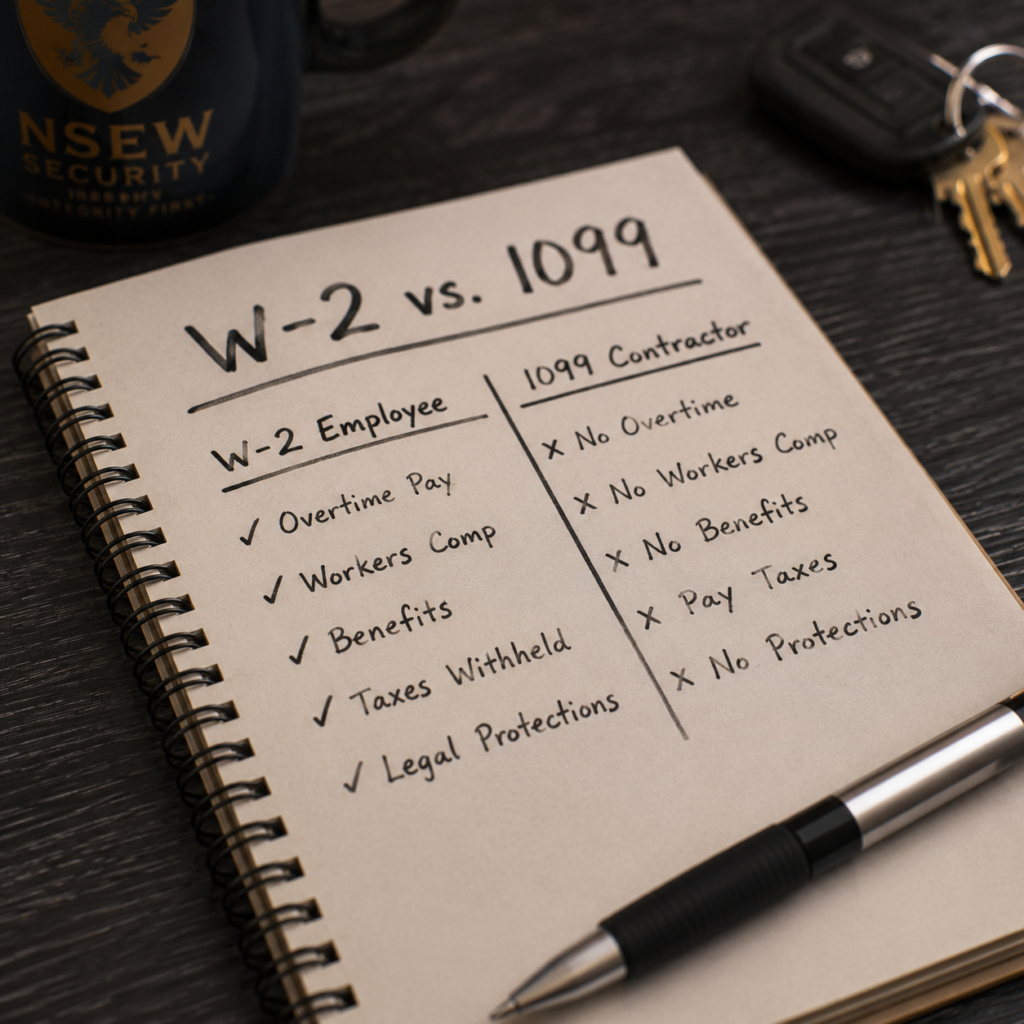
Every so often, a security officer tells us they were offered a job that pays a few dollars more per hour because the company pays everyone as 1099 contractors.
At first glance, it sounds like a great deal.
A higher hourly rate. A bigger paycheck. No taxes being withheld.
But what many officers don’t realize is that a slightly higher hourly rate can disappear quickly when they lose the protections that come with being a W-2 employee.
At NSEW Security, we don’t classify our security officers as 1099 contractors. We hire them as employees because we believe that’s the correct way to operate—and because it’s better for our officers, our clients, and our company.
A Security Officer Usually Isn’t an Independent Contractor
Independent contractors operate their own businesses. They decide how the work is performed. They typically provide their own equipment, set their own schedules, negotiate their own contracts, and often work for multiple clients.
Most security officers don’t work that way. They wear the company’s uniform. They follow company policies. They work the schedule assigned to them. They answer to supervisors. They patrol according to company procedures.
Those are characteristics of an employee—not an independent contractor. Simply handing someone a 1099 at the end of the year doesn’t automatically make them one.
Why 1099 Contractors See a Misleading Higher Rate
Many officers focus on the hourly rate. What they don’t always calculate is everything they’re giving up.
A 1099 contractor is generally responsible for paying both the employer and employee portions of certain payroll taxes. They may also need to make estimated tax payments throughout the year to avoid penalties.
More importantly, they often lose employ
ment protections that many W-2 employees take for granted.
Overtime Can Be Worth More Than the Raise
Security officers frequently work long shifts, cover call-offs, and pick up extra hours. As a W-2 employee, those overtime hours may be paid at time-and-a-half when required by law. Independent contractors generally are not covered by overtime laws in the same way.
That extra dollar or two per hour can quickly disappear when overtime premiums are no longer part of the equation.
What Happens If You’re Hurt on the Job?
Security work carries real risks. Officers respond to disturbances. They patrol dark parking lots. They investigate suspicious activity. They sometimes intervene before law enforcement arrives.
If an officer is injured while working as a properly classified employee, workers’ compensation insurance is designed to provide important protections, subject to the applicable policy and state law. A person classified as an independent contractor may not have those same protections unless appropriate coverage is in place.
That’s not something anyone wants to discover after an injury.
Clients Should Ask Questions, Too
Property owners hire security companies to reduce risk—not introduce it. If a security company is using 1099 contractors, clients should ask important questions:
- Are those contractors properly classified?
- Do they carry their own commercial liability insurance?
- Do they have workers’ compensation coverage if required?
- Has your insurance carrier approved this arrangement?
- What happens if one of those contractors is involved in an incident?
These aren’t uncomfortable questions. They’re responsible business questions.
Insurance Companies Pay Attention to This
Our own insurance carrier requires us to obtain proof of insurance from any legitimate independent contractor we hire. If that contractor cannot provide the required coverage, our carrier may treat that exposure as ours and charge us additional insurance premiums because we are effectively assuming the risk.
That requirement exists because insurance companies understand the potential exposure created when contractors are uninsured or improperly classified. In some situations, improper classification can also create disputes over whether an insurance policy applies as expected, potentially leading to delays or litigation while coverage issues are resolved.
Hiring 1099 Contractors the Wrong Way Can Become Very Expensive
Some companies use 1099 contractors because they believe it reduces payroll costs. But if that classification is later challenged, the company could face liability for unpaid payroll taxes, workers’ compensation premiums, unemployment contributions, wage claims, interest, penalties, and other employment-related obligations.
The short-term savings can become a very expensive long-term problem.
Integrity First
At NSEW Security, our motto is Integrity First.
That philosophy doesn’t stop at the client relationship. It applies to how we hire our officers, how we insure our business, and how we protect the people who work for us.
We believe security professionals deserve the protections that come with being employees. We believe clients deserve to know the people protecting their property are working for a company that operates professionally. And we believe doing business the right way is always a better investment than taking shortcuts.
Sometimes the cheapest way to run a security company is also the riskiest. We’re simply not willing to build our business that way.